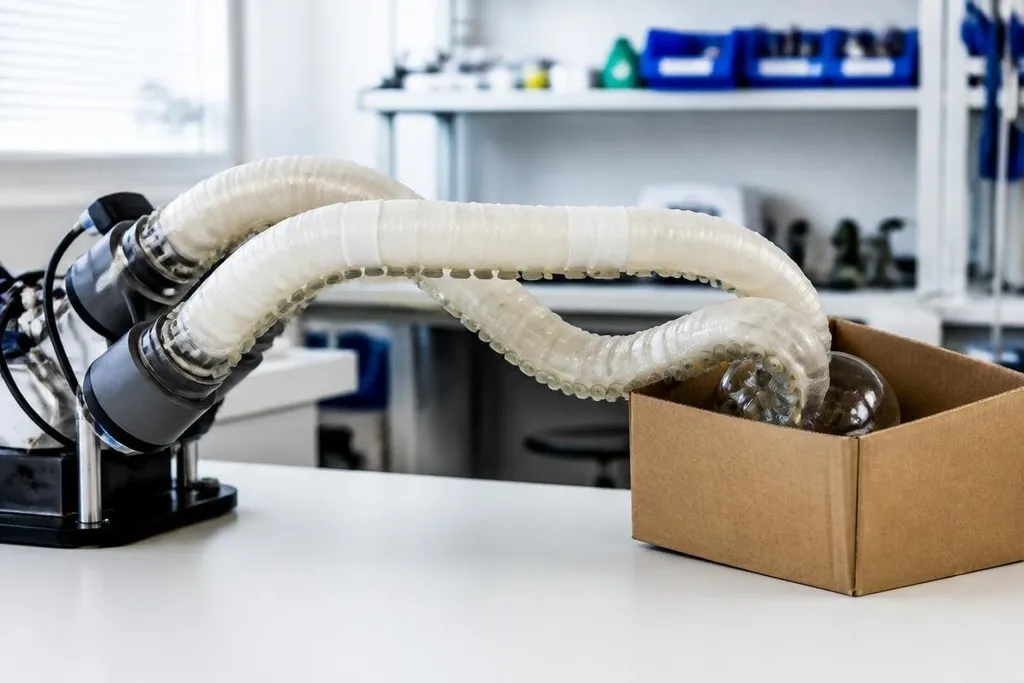
An octopus arm has no bones, yet it can bend, shorten, lengthen, and grip objects of many shapes. Robot builders are borrowing that body plan to make machines that work around fragile items and tight spaces.
The idea matters most where a metal arm meets objects that vary from one cycle to the next. Soft parts can conform to those objects, but they also bring harder problems in control, sensing, repair, and force.
Quick read
- Soft arms bend through their length instead of turning at a few fixed joints.
- Suction cups can help with gripping, sensing contact, or both.
- The trade-off is lower precision and a harder path to maintenance.
How the octopus design works
A standard robot arm moves through set joints. Each joint turns around a known axis, which makes its position easier to calculate. The animal's arm takes a different route: muscles run through a flexible body, so many parts can move at once.
Robotic versions often use soft materials, air pressure, cables, or shape-changing chambers. A controller changes the pressure or cable tension, and the arm bends where the force takes effect. That can produce a smooth curve instead of a sequence of sharp joint angles.
The arm can also wrap around an object. A rigid gripper may need the object to sit in a narrow grasp zone. A soft arm can make contact along a larger area, which reduces the chance of crushing a thin or delicate item.
Suction adds another useful detail. Each sucker can attach to a surface and sense contact. A robot with suction cups may use the same part to hold an object while checking whether the seal is working.
Where soft arms make sense
This design fits tasks where shape, surface, or position changes from one item to the next. Food handling is one example because products can be soft, uneven, or easy to mark. A rigid claw set for one shape may need new fingers or new settings for another.
Underwater work is another possible use. A soft arm can move with less risk of hitting nearby equipment, coral, or a submerged structure. Its body can bend around obstacles instead of forcing the whole robot to line up with them.
Inspection work also benefits from contact over a wider area. An arm that presses gently against a pipe or curved surface can keep a sensor close while the robot moves along it. That does not remove the need for position data, but it can make contact easier to maintain.
Contact gives the arm a signal, yet the controller must turn that signal into a change in force or position. Reports from Robot24 can connect soft-robotics control claims with named machines and test settings before the next section looks at where that control breaks down.
The control problem
Soft movement creates more possible shapes than a rigid arm with a few joints. That freedom helps the robot fit around objects, but it also makes the arm harder to model.
A controller needs to know where the arm is, how much force it is applying, and whether the object has moved. Cameras can help with position. Pressure sensors, stretch sensors, and contact sensors can add information from the arm itself.
That information still has to become a safe movement. If the controller reacts too slowly, the arm may press too hard. If it reacts to noisy sensor data, the arm may change shape when it should hold steady.
Precision is another limit. A soft arm can reach a target, yet repeat the same path less closely than a rigid arm. That makes it a poor fit for tasks that need a tool tip to return to the same point with very little error.
What buyers should check
A soft robot can look gentle in a demonstration while hiding the work needed to run it every day. Before choosing one for a real task, check the parts that affect downtime and control:
- Object range: Record the smallest, largest, heaviest, and most fragile items it must handle.
- Contact method: Check whether the gripper uses air, cables, suction, or a mix of methods.
- Sensing: Ask how the system detects position, grip force, seal loss, and contact.
- Repeatability: Find the measured position error over repeated cycles, not a single successful run.
- Service work: Check how operators replace a damaged skin, tube, cable, or sensor.
- Task speed: Compare the full cycle time, including approach, grip, move, release, and reset.
These checks connect the body design to the work. A robot that handles irregular objects well may still lose time through slow pressure changes or frequent part replacement.
What happens next
The most useful progress will come from better sensing and simpler service, not from making soft arms look more like animals. A machine that can detect contact, hold a safe force, and let a technician replace worn parts has a clearer path to regular use.
I'd choose an octopus-inspired arm for changing, delicate objects before choosing it for fixed, high-precision assembly. The open question is whether its grip and flexibility can outweigh the control and maintenance cost in a working cell.